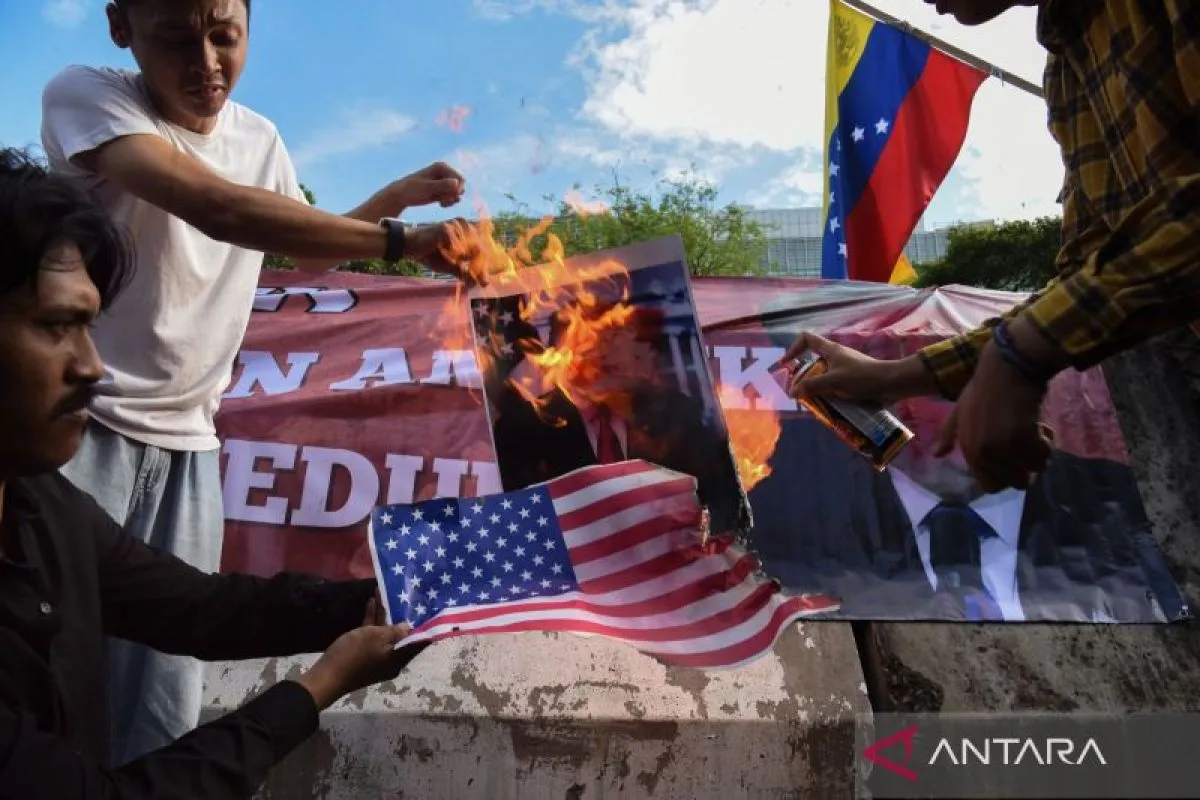
Jakarta (ANTARA) - Caracas erupted into chaos on January 3, when US Special Forces abducted Venezuelan President Nicolas Maduro and his wife, Cilia Flores, in a daring operation that sent shockwaves through the international community.
Under orders from President Donald Trump, the couple was transported to New York, where they now face federal charges alleging involvement in drug trafficking and ties to gangs designated as terrorist organizations.
The operation drew immediate condemnation from governments across the globe. Latin American neighbors, as well as long-time allies Russia and China, denounced the US strike as a blatant violation of international law.
Indonesia joined the chorus of concern, warning the attack could set a dangerous precedent for international relations and undermine the principles of sovereignty and diplomacy.
According to a statement from the Indonesian Foreign Ministry, Indonesia stressed that the international community must respect the rights and will of the Venezuelan people to determine their own future.
The ministry urged all parties to “exercise dialogue and self‑restraint and to fully respect international law, including the principles enshrined in the United Nations Charter and international humanitarian law.”
It also called for the protection of civilians, saying their safety and well-being must remain a top priority amid escalating tensions.
In response to this political turmoil, Indonesia’s primary interest is to protect its citizens in Venezuela.
As of Monday (January 5), the Indonesian Embassy in Caracas confirmed the safety of 37 Indonesians in Venezuela, as the situation gradually stabilized following the swearing-in of Delcy Rodriguez as Venezuela’s interim president.
The embassy has also prepared a contingency plan to ensure the safety of Indonesian citizens should the security situation in Venezuela escalate again.
In terms of the economy, the US intervention in Venezuela contributed to a 15-point (0.09 percent) weakening of the rupiah exchange rate on Monday, from Rp16,725 per US$ to Rp16,740 per US$.
The conflict has impacted the sale of government securities (SBN), particularly among foreign investors, and increased yields as investors shifted to safe-haven assets such as gold and the US dollar, according to Rully Nova, analyst at Woori Saudara Bank.
Meanwhile, Finance Minister Purbaya Yudhi Sadewa assessed that the political escalation between the US and Venezuela has not had a significant impact on the Indonesian economy, particularly the stock market.
According to him, the market reaction following this development actually shows positive sentiment.
"From my perspective, it is a bit far-fetched. If you look at the stock market, it is actually rising, so they see it as a bit positive, which is a bit odd, actually,” he said Monday.
From a macroeconomic perspective, Purbaya stated that the potential impact of the US-Venezuela escalation on Indonesia is relatively limited, as Venezuela has long been inactive in the global oil market due to its limited production capacity.
Indonesian capital market observer Reydi Octa said domestic macroeconomic stability supported the performance of the Jakarta Composite Index (JCI) amid the conflict.
"The JCI’s strengthening today was driven more by domestic and regional sentiment, rather than the US-Venezuela conflict," he noted Monday.
He explained that market players viewed the conflict between the two countries as not yet having a systemic impact on global financial markets, thus not triggering significant selling.
Domestically, he said the JCI was supported by macroeconomic stability, early-year optimism, and a rotation into stocks in the energy and gold sectors, which benefited from global uncertainty.
Boost oil production
After abducting Maduro, Trump said the US will “run” Venezuela until a safe transition and take control of the country’s massive oil reserves.
The US president wants American oil companies to invest billions of dollars into Venezuela, which has the largest crude oil reserves in the world, to mobilize the largely untapped resource.
Trump said that US companies will fix Venezuela’s badly broken oil infrastructure and start generating revenue for the country.
With an estimated 303 billion barrels, Venezuela is home to the world’s largest proven oil reserves.
But the amount of oil the country actually produces today is tiny by comparison. In November, Venezuela produced an estimated 860,000 barrels per day, according to the latest International Energy Agency report.
That is barely a third of what it was 10 years ago and accounts for less than one percent of world oil consumption.
Responding to this development, Indonesia seeks to increase national oil reserves and optimize production as anticipatory measures, according to a spokesperson for the Energy and Mineral Resources Ministry, Dwi Anggia.
Steps to increase national oil production include optimizing the use of technology and production techniques, such as fracking, enhanced oil recovery (EOR), and horizontal drilling.
In addition, the government is offering fiscal reforms, accelerated licensing, and increased exploration investment in frontier areas to attract upstream oil and gas investors, she continued.
Anggia said the government is also pursuing production increases by reactivating 4,500 idle wells, while continuing to monitor the situation in Venezuela.
At this time, the government has not yet seen a direct impact from the situation in Venezuela on fuel supply or prices, noting that Indonesia does not source crude oil from the country.
The conflict has no significant impact on global oil prices or international oil trade, considering conditions in Venezuela differ from those of oil producers in the Middle East, Anggia noted.
Conflicts in the Middle East tend to make oil prices highly volatile, as the region is home to many OPEC member states, she added.
The US strike on Venezuela has so far not affected the operations of PT Pertamina Internasional Eksplorasi dan Produksi (PIEP), the international upstream subholding of state-owned energy company Pertamina.
PIEP owns 71.09 percent of the shares of the French oil and gas company Maurel & Prom (M&P), which has assets in Venezuela.
As a precautionary measure, the firm continues to coordinate with the Indonesian Embassy in Caracas to maintain workers’ safety and ensure normal operations, according to its relations manager, Dhaneswari Retnowardhani.
PIEP has been actively acquiring and managing oil and gas fields in various countries to support domestic energy needs and strengthen national energy security.
In addition to Venezuela, Pertamina has oil and gas assets in 10 other countries.
By continuing to closely monitor the situation, Indonesia must be able to take quick and appropriate measures to anticipate any impacts arising from geopolitical developments, including the current turmoil in Venezuela.