

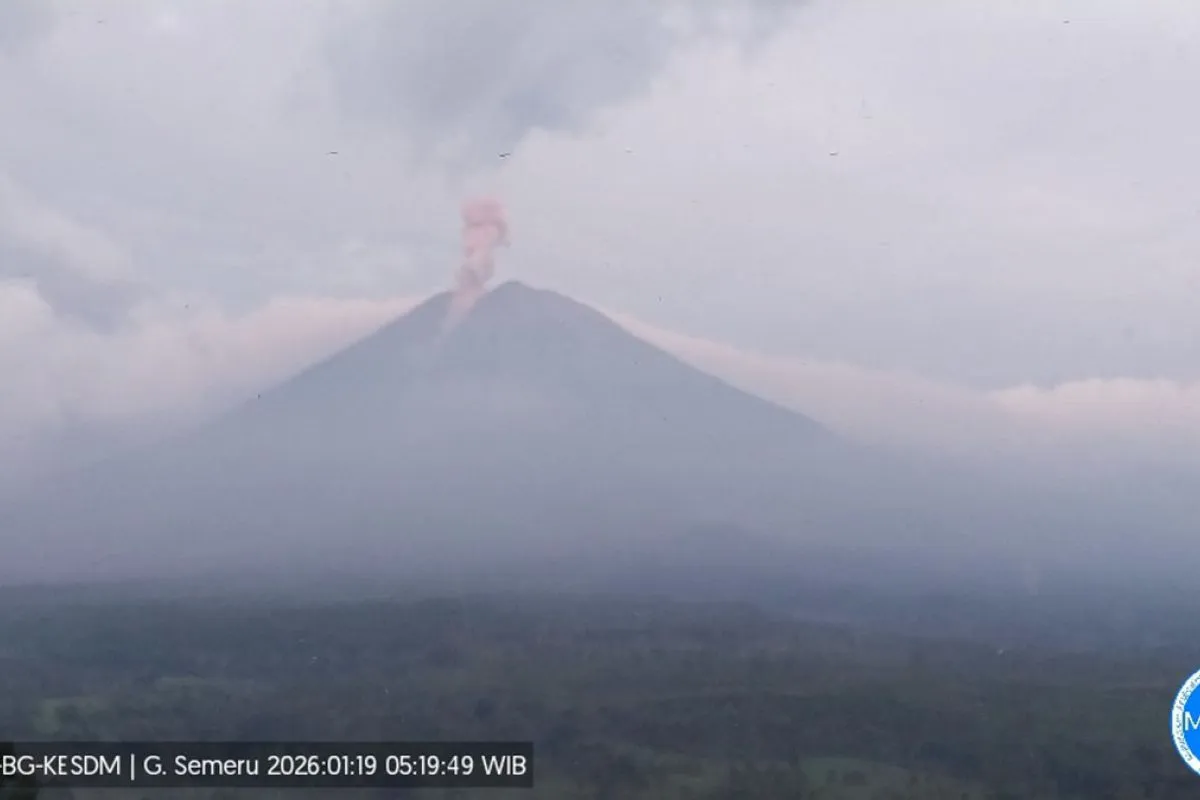
Lumajang, East Java (ANTARA) - Mount Semeru, which stands 3,676 meters above sea level in East Java, erupted six times on Monday morning, producing ash plumes ranging from 300 meters to 1 kilometer in height.
The first eruption occurred at 12:22 a.m., followed by subsequent eruptions at 12:36 a.m., 12:50 a.m., 5:19 a.m., 6:44 a.m., and 8:36 a.m.
"The highest eruption occurred at 5:19 a.m., with an observed eruption column height of approximately 1,000 meters above the summit," an officer at the Mount Semeru Observation Post, Liswanto, informed on a report on Monday.
According to him, the ash column was observed to be white to gray in color with moderate intensity, drifting toward northeast.
Mount Semeru's activity on Monday, from 12:00 a.m. to 6:00 a.m. recorded 36 eruption earthquakes with amplitudes of 12-22 mm and durations of 86-156 seconds, followed by three avalanche earthquakes with amplitudes of 4-7 mm and durations of 33-73 seconds.
"Mount Semeru also experienced three harmonic tremors with amplitudes of 10-11 mm and durations of 118-360 seconds, as well as one distant tectonic earthquake with an amplitude of 7 mm, a frequency of 19 seconds, and a duration of 39 seconds," he added.
Liswanto noted that Mount Semeru remains at Alert Level III. Accordingly, the Center for Volcanology and Geological Hazard Mitigation (PVMBG) has advised the public to refrain from all activities in the southeastern sector along Besuk Kobokan within a 13-kilometer radius of the summit, which is the eruption center.
“Beyond that distance, the public should also avoid activities within 500 meters of the riverbanks along Besuk Kobokan due to the potential expansion of pyroclastic flows and lava flows, which may reach up to 17 kilometers from the summit,” he said.
The public is also advised to avoid activities within a 5-kilometer radius of the crater or summit of Mount Semeru due to the risk of ejected rocks.
Residents are urged to remain alert to the potential for pyroclastic flows and lava avalanches along rivers and valleys originating from the summit of Mount Semeru, particularly along Besuk Kobokan, Besuk Bang, Besuk Kembar, and Besuk Sat, as well as the possibility of lava flows in smaller rivers that are tributaries of Besuk Kobokan.


