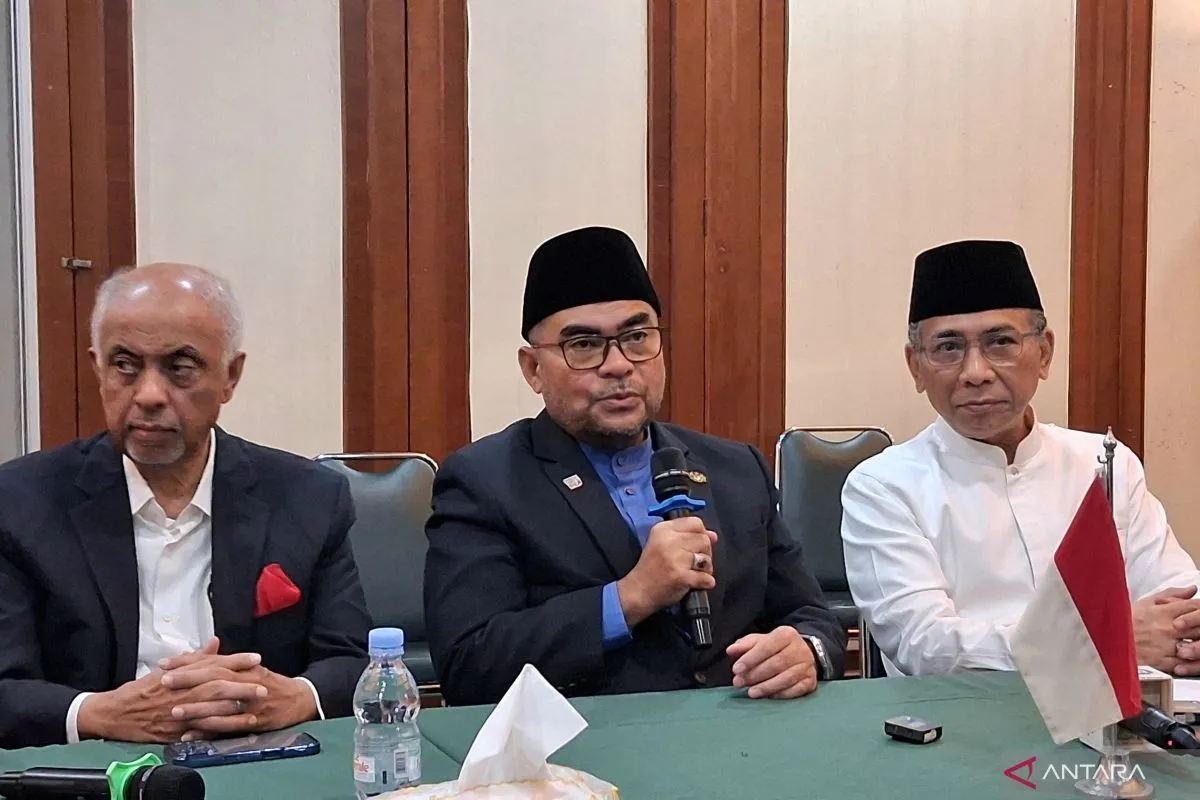
Jakarta (ANTARA) - Indonesia's Nahdlatul Ulama Executive Board (PBNU) is seeking stronger cooperation with Malaysia to bolster the Islamic economy and halal industry in Southeast Asia, with the aim of creating jobs and enhancing the region’s global competitiveness.
PBNU Chairman Yahya Cholil Staquf said the issue was discussed during a reciprocal visit by a Malaysian delegation aimed at strengthening bilateral ties through a people-to-people approach.
“We discussed several concrete opportunities for cooperation, ranging from Islamic economy-based business development and agriculture to academic collaboration,” he said during a press conference following the meeting in Jakarta on Friday.
He stressed that both Indonesia and Malaysia share a common commitment to developing businesses within the framework of the Islamic economy and halal industry.
Staquf noted that one of the key agenda items discussed was the potential organization of an international halal expo in Indonesia.
In addition, PBNU is preparing the Nahdlatul Ulama Harvest Maslaha platform, a global Islamic investment vehicle designed to accommodate various collaborative initiatives between Nahdlatul Ulama, Indonesia’s largest Muslim organization, and Malaysian stakeholders.
According to him, Nahdlatul Ulama possesses strong grassroots influence through its large membership base, which can help support strategic government programs, particularly in the village economy sector.
“International cooperation with Malaysia can facilitate the transfer of knowledge and technology to support higher food production, the development of small and medium enterprises (SMEs), and the expansion of international business literacy among the public,” he explained.
He added that collaboration in knowledge and technology sharing could help accelerate the achievement of national development targets.
Meanwhile, Malaysian Senator Datuk Seri Mujahid Yusof Rawa said the delegation’s visit to Jakarta reflected a shared commitment to strengthening economic cooperation.
He noted that Southeast Asia enjoys relatively high levels of stability and peace, which should be leveraged to advance shared economic prosperity.
According to him, the visit also opens opportunities for cooperation in Islamic banking and finance. He added that the people-to-people initiative would complement the long-established government-to-government relations across Southeast Asia.
He said Nahdlatul Ulama was chosen as a partner because of its extensive network, long history, and strong foundation in Islamic values.
Going forward, the cooperation is expected to expand to Thailand, Singapore, Cambodia, Vietnam, and other Asian countries to strengthen the region’s position as an emerging global economic powerhouse driven by the Islamic economy and halal industry.
Pewarta: Lintang Budiyanti, Raka AdjiEditor : Vicki Febrianto
COPYRIGHT © ANTARA 2026


