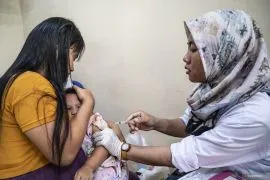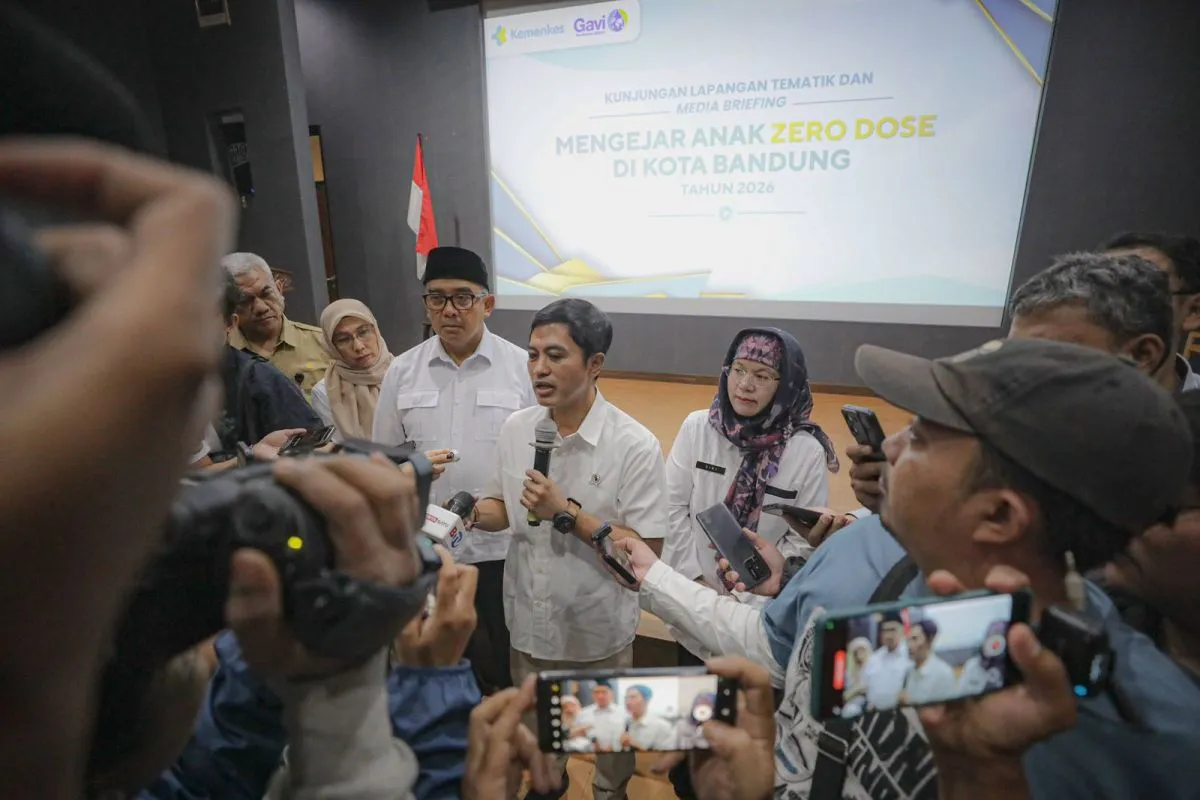
Bandung, West Java (ANTARA) - Deputy Minister of Health Dante Saksono Harbuwono has called for faster immunization efforts as the number of zero-dose children in Indonesia, or children who have not received any vaccines, reached 2.3 million in 2025.
“If we do not move quickly to reach these zero-dose children, it could create serious problems in the future. Even a slight decline in coverage can trigger an outbreak,” he said during a field visit in Bandung, West Java.
He emphasized that although national immunization coverage has reached 80 percent, the figure is still below the minimum 90 percent threshold required to achieve herd immunity.
According to Harbuwono, the continued emergence of measles and other infectious diseases indicates that gaps in immunization coverage remain in several communities.
He also noted that the high number of zero-dose children in Indonesia has been driven partly by misinformation surrounding vaccines, including debunked claims linking vaccines to autism.
Addressing concerns over porcine content in vaccines, Harbuwono referred to the measles vaccine, explaining that porcine trypsin is used during the cell separation process in production. However, he stressed that extensive purification ensures the final product is free from the enzyme.
“This has been verified by the Indonesian Ulema Council (MUI), which confirmed that the final measles vaccine does not contain any porcine-derived elements,” he said.
In this regard, he underscored the important role of integrated health posts (posyandu), regional leaders, the media, and religious figures in educating the public that vaccines are safe, halal, and beneficial for the community.
During the visit, the deputy minister also praised West Java Province for reducing the number of zero-dose children from 102,000 to 67,000 within one year.
“Bandung has a strong opportunity to become a national model through innovation in health services and the strengthening of posyandu,” he remarked.
Bandung Mayor Muhammad Farhan said that the lack of vaccination, particularly for the primary DPT-1 series protecting against diphtheria, pertussis, and tetanus, poses a serious risk to children’s basic rights.
He described disinformation and public resistance as major obstacles to immunization efforts and called for broader collaboration involving all elements of society to address the issue.
Pewarta: Ricky Prayoga, Raka AdjiEditor : Vicki Febrianto
COPYRIGHT © ANTARA 2026